PRIVACY POLICY AND COOKIES
Last Updated: January 21, 2025
This web page (the "Website") was generated by the domain owner using the Bodis Domain Platform owned by Bodis, LLC ("we", "us", or "our").
Disclaimer: We have no relationship with any advertisers, advertisements, or third-party content that may be displayed on the Website. Reference to any specific service or brand is not controlled by us and does not constitute or imply any association, endorsement, or recommendation.
This Privacy Policy describes our practices with respect to the collection, manipulation, disclosure, and other uses of personal information. This Privacy Policy applies to information collected by us through the Website but does not apply to information collected by any person or entity other than us, even if related to the Website (such as by our third-party service providers or advertisers). We will not be responsible or liable for the personal data privacy practices of third parties.
PLEASE READ THIS PRIVACY POLICY CAREFULLY BEFORE USING THE WEBSITE. BY USING THE WEBSITE OR BY CLICKING TO ACCEPT OR AGREE TO OUR TERMS OF USE ("TERMS") WHEN THIS OPTION IS MADE AVAILABLE TO YOU, YOU ACCEPT AND AGREE TO BE BOUND AND ABIDE BY OUR TERMS, INCLUDING THIS PRIVACY POLICY. IF YOU DO NOT WANT YOUR PERSONAL INFORMATION COLLECTED, USED, OR DISCLOSED IN THE MANNER DESCRIBED IN THIS PRIVACY POLICY, OR IF YOU DO NOT AGREE WITH ANY TERM OR CONDITION IN OUR TERMS, INCLUDING THIS PRIVACY POLICY, THEN YOU MUST NOT ACCESS OR USE THE WEBSITE (IN WHOLE OR IN PART).
Changes to this Privacy Policy: This Privacy Policy may change from time to time. If we make changes, we will notify you by revising the date at the top of this Privacy Policy. Amendments will take effect immediately on our posting of the updated Privacy Policy. Your continued access or use of the Website after receiving the notice of changes means you accept the updated Privacy Policy, so please check this policy periodically for updates.
What Information We Collect and How We Collect It
We receive and collect several types of information about you, such as the information described below.
Information you provide to us: From time to time, you may provide us with certain personal information such as your name and email address.
Information we collect automatically: As you navigate through and interact with the Website, we and third parties acting on our behalf may use automatic data collection technologies to collect certain information.
Information we receive from third parties: We may obtain information about you from sources other than you (such as our business partners). Any content or information submitted by you to third parties will be used and disclosed by such third parties in accordance with their respective privacy policies. You should review the privacy policies and practices of such third parties prior to disclosing information to them.
Our Collection Practices with Respect to Certain Specific Information:
Device Information. When you access or use the Website through your computer, mobile phone or other device, we may collect information regarding and related to your device, such as hardware models and IDs, device type, operating system version, the request type, the content of your request and basic usage information about your use of the Website, such as date and time.
Communications with Us. We may collect information about your communications with us, including relating to support questions, your requests, and other inquiries.
Cookies and Other Automatic Tracking Technologies
Description of the Technologies Utilized on the Website: We may use various technologies to collect and store information when you access or use the Website, including sending cookies, embedded scripts, web beacons, pixel tags or other anonymous identifiers to your device, or otherwise tracking your activities on the Website over time. We also may use these technologies to collect information about your online activities over time and across third-party websites or other online services (a practice known as "behavioral tracking"). The information collected through these technologies, standing alone, cannot be used to determine your identity. Such information may, however, be combined in a way that makes it become personally identifiable information (i.e., information that can identify you). For example, we may tie this information to personal information about you that we collect from other sources or that you provide to us. If this happens, we will treat the combined information as personally identifiable information.
Cookies: The Website uses cookies, which are small text files that, within the scope of your visit to the Website, are transmitted to your browser and are stored by your browser on your computer for later retrieval. You yourself can determine, through settings in your browser, the extent to which cookies can be placed and retrieved. If you deactivate your setting of cookies in the Internet browser used, not all functions of the Website may be entirely usable. Cookies are used to make the Website more user-friendly (known as "Necessary Cookies"). Without the use of these cookies, the number of unique users on the Website cannot be determined. Cookies also provide you with certain functions on the Website. In addition, cookies are also used for the website presence, which, for example, allows surfing behavior to be analyzed.
Third-party content, features or application providers may collect information: Some content (including advertisements), applications, or features on the Website may be served by third parties, including our third-party service providers, content providers, advertisers, ad networks and servers, and other application providers. These third parties may collect information about you when you use the Website using cookies alone or in conjunction with web beacons or other tracking technologies. Please note that the information collected by these third parties may be associated with your personal information and that these third parties may collect information, including your personal information, about your online activities over time and across different websites and other online services. They may use this information to provide you with interest-based (behavioral) advertising or other targeted content. We do not control these third parties' tracking technologies or how they may be used. If you have any questions about an advertisement or other targeted content, you should contact the responsible provider directly.
We may use third-party service providers to monitor and analyze the use of the Website. For example, we may use Google Analytics as one of our analytics service providers that tracks and reports website traffic. For more information on the privacy practices of Google, please visit the Google Privacy & Terms web page. To learn more about how Google collects and uses data here. To opt out of Google Analytics Advertising Features please use Google Ad Settings. To opt out of Google Analytics entirely please use this link.
We may use third-party service providers, such as Google, to display advertising content on the Website. When you visit the Website, a request is sent to Google and Google processes the domain name and the IP address of the Website visitor to dynamically return the advertising content of the Website. Google sets a cookie. The display of the advertising content is the primary purpose of the Website, and the setting of the cookie is technically necessary to provide the advertising content of the Website. The advertising content is not personalized, and no profile of the Website visitor is generated. You can prevent the setting of cookies by Google by setting your browser accordingly, in particular by suppressing cookies from third-party providers, and thus prevent cookies from being set. See here for further information:
https://www.google.com/policies/privacy/partners/.
Choices as to Cookies and Other Automatic Tracking Technologies: It may be possible to disable some (but not all) cookies or automatic data collection technologies through your device or browser settings, but doing so may affect the functionality of all or a portion of the Website. The method for disabling cookies or other automatic collection technologies may vary by device and browser but can usually be found in preferences or security settings. For example, iOS and Android devices each have settings which are designed to limit forms of ad tracking.
Conversion Tracking Pixel: Pixels from the following providers may be used for conversion measurement:
Facebook Inc., 1601 S. California Ave, Palo Alto, CA 94304, USA ("Facebook");
Taboola Inc., 16 Madison Square West, 7th fl., New York 10010, USA ("Taboola");
Outbrain UK Limited, 5 New Bridge Street, London, EC4V 6JA, UK ("Outbrain");
Twitter, Inc., 1355 Market Street, Suite 90, San Francisco, CA 94103, USA ("Twitter");
Snap Inc., 63 market Street, Venice, CA 90291, USA ("Snapchat");
TikTok Inc., 10100 Venice Blvd., Culver City, CA 90232, USA ("TikTok");
Pinterest Europe Ltd., Palmerston House 2nd Floor, Fenian Street, Dublin 2, Ireland ("Pinterest");
(hereinafter each referred to as the "Provider", or collectively the "Providers").
By setting the conversion tracking pixel, the behavior of users can be tracked after they have been redirected to the target page by clicking on an advertisement. This procedure is used to evaluate the effectiveness of the Provider advertisements for statistical and market research purposes and can help to optimize future advertising measures.
The data collected does not allow us to draw any conclusions about the identity of users. However, the data is stored and processed by the respective Provider so that a connection to the respective user profile is possible and the respective Provider can use the data for its own advertising purposes in accordance with its own data protection guidelines. This allows the Provider to enable advertisements to be placed on their website and outside their website. This use of the data cannot be influenced by us as a website operator.
You will find further information on the protection of your privacy as well as the possibility of revoking your consent in the privacy policies of the respective Providers:
https://www.facebook.com/about/privacy/https://www.taboola.com/privacy-policyhttps://www.outbrain.com/legal/privacyhttps://twitter.com/en/privacyhttps://www.snap.com/en-US/privacy/privacy-policyhttps://www.tiktok.com/legal/privacy-policy?lang=ushttps://policy.pinterest.com/en/privacy-policyHow We Use Your Information
We may use the information we collect for various lawful business purposes. Among others, these purposes may include using this information, including your personal information, to:
Present and provide the Website, and related content to you. For example, to provide the Website, including its features and content (including advertisements) to you and/or other users.
Contact you and provide you with information. For example, if you use the "contact us" form or functionality on the Website, we might contact you via e-mail or other communications to provide you with information or to respond to comments, inquiries, and other information submitted by you.
Analyze, improve, and manage the Website and operations. For example, we might use your personal information to: (i) understand and anticipate your needs and preferences, (ii) better understand your use of the Website, (iii) customize and tailor website content and advertising, (iv) improve our marketing and promotional efforts, (v) engage in statistical analysis and market research, and (vi) provide feedback or information to our business partners, vendors, advertisers and other third parties. We may also use the information and data we collect (including your personal information) to improve and enhance the Website (in whole or in part) and for other development, diagnostic and corrective purposes in connection with the Website.
Resolve problems and disputes and engage in other legal and security matters. For example, we may use the information we collect to comply with, monitor compliance with and enforce this Privacy Policy, our Terms (including any terms and conditions incorporated or referenced in our Terms) and any other applicable agreements and policies, meet other legal and regulatory requirements, and protect the security and integrity of the Website. We might also use your personal information to authenticate activity, detect, investigate, and to prevent malicious conduct or unsafe experiences or address security threats, or protect public safety. We might also use information that we collect to investigate any complaint you make regarding the Website, content, or other related matters, to provide evidence in any dispute or anticipated dispute between you and us, or to prevent fraud or other criminal or otherwise inappropriate activities.
To fulfill any other purpose for which you provide it. For example, if you share your name and contact information to ask a question about our company, we will use that personal information to respond to your inquiry.
Comply with a request from you in connection with the exercise of your rights. For example, if you send us a privacy request, we will use your personal information to review your request and respond to your request.
Other Purposes. We may also use your personal information in other ways. To the extent required by applicable law, we will provide notice at the time of collection and obtain your consent.
How We Disclose Your Information
General Disclosure of Your Information: We may disclose or share the information we collect, including your personal information:
to our third-party service providers, vendors, partners, or suppliers so that they may provide support for our internal and business operations, including for data processing, data verification, data storage, surveys, research, internal marketing, delivery of promotional, marketing and transaction materials and Website speed, maintenance and security. For example, we use:
Google Analytics so that they can help us understand how our customers use the Website -- you can read more about how Google uses your personal information here:
https://www.google.com/intl/en/policies/privacy/. You can also opt-out of Google Analytics here:
https://tools.google.com/dlpage/gaoptout.
Content Delivery Network ("CDN") services (such as Cloudflare, Inc.) to increase the security and delivery speed of the Website. With the CDN, content from the Website such as images, fonts, stylesheets, and scripts are delivered to you faster via a network of servers. For this purpose, personal data, including your IP address, may be processed by the provider of the CDN. Further information can be found in Cloudflare's privacy policy here:
https://www.cloudflare.com/privacypolicy/.
Services provided by Google to display advertising content on the Website. You can review Google's privacy policy regarding advertising here:
https://policies.google.com/technologies/ads. That page also provides information on how to manage what information is collected and how to opt out of collection.
to our affiliates and their respective employees, agents and representatives involved in delivering the Website to you;
to fulfill the purpose for which you provide it;
to third parties when you engage in certain activities through the Website;
to any person who, in our reasonable judgment, is authorized to receive your personal information as your agent, including as a result of your business dealings with that person (for example, your attorney);
as required by applicable law or ordered by a court, regulatory or administrative agency;
as we deem necessary, in our sole discretion, if we believe that you are violating any applicable law, rule, restriction or regulation, or are otherwise interfering with another's rights or property, including our rights or property;
if requested by authorities in the event of any act or instance of local, regional or national emergency;
to enforce our Terms, including this Privacy Policy, and any other applicable agreements and policies;
with your consent;
to otherwise enforce or protect our rights; and
in connection with a Business Transfer (as defined below).
Please note that the list above is not exhaustive and that we may, to the extent permitted by applicable law, disclose the information we collect to third parties at any time, for any lawful purpose, without notice or compensation to you.
When we disclose the information we collect to third parties, such information will become permanently subject to the information use and sharing practices of the third party, and the third party will not be restricted by this Privacy Policy with respect to its use and further sharing of such information. Furthermore, these third parties may further disclose, share and use this information. By submitting information (including your personal information) to us, you expressly consent to such disclosure and use of such information. If you do not want this information (including your personal information) shared as described above, then you should not provide us with such information.
Other Disclosures by Us:
Aggregation and De-Personalization. We may use and disclose any de-identified information for any lawful purpose, including for any commercial purpose. De-identified Information means information that does not identify you, including any identifiable information de-identified by either combining it with information about others, for example, by aggregating your personal information with information about other persons, or by removing characteristics, such as your name, that make the information personally identifiable to you.
Business Transfers. We may disclose, lease, sell, assign, or transfer the information we collect (including your personal information) to third parties in connection with a Business Transfer. A "Business Transfer" means a sale, acquisition, merger, consolidation, reorganization, bankruptcy, or other corporate change involving us, even if the Business Transfer is only being contemplated and regardless of whether the Business Transfer relates to a part of or our whole business. Nothing in this Privacy Policy is intended to interfere with our ability to transfer all or part of our business, equity, or assets (including the Website) to an affiliate or independent third party at any time, for any lawful purpose, without notice or compensation to you.
Circumvention of Security Measures: We use certain technical, administrative, and organizational security measures to keep your personal information safe. However, despite our efforts, please be aware that methods of transmission and electronic storage are not completely secure. We cannot guarantee the privacy or security of your personal information, as third parties may unlawfully intercept or access transmissions or electronic storage. Further, to the extent permitted by law, we are not responsible for circumvention of any privacy settings or security measures of the Website. Therefore, you use the Website at your own risk, you should not expect that your personal information will always remain private, and we do not guarantee the performance or adequacy of our security measures. In the event that an unauthorized third party compromises our security measures, to the extent permitted by law, we will not be responsible for any damages, directly or indirectly, caused by an unauthorized third party's ability to view, use or disseminate your personal information.
Choices About How We Use and Disclose Your Information
We strive to provide you with choices regarding our collection, use and disclosure of the information that we collect (including your personal information). Below are some mechanisms that provide you with control over such collection, use or disclosure:
Cookies and Other Tracking Technologies. It may be possible to disable some (but not all) cookies or automatic data collection technologies through your device or browser settings, but doing so may affect the functionality of the Website. The method for disabling cookies or other automatic collection technologies may vary by device and browser, but can usually be found in preferences or security settings. You can exercise your preferences in relation to cookies served on the Website by taking the steps outlined below.
First-Party Cookies. You can use the browser with which you are viewing the Website to enable, disable or delete cookies. To do this, follow the instructions provided by your browser (usually located within the "Help", "Tools" or "Edit" settings). Please note, if you set your browser to disable cookies, you may not be able to access secure areas of the Website. Also, if you disable certain cookies, other parts of the Website may not work properly. You can find more information about how to change your browser cookie settings at
allaboutcookies.org.
Third-Party Cookies. To opt-out of third-party advertising networks and similar entities that use advertising cookies go to
aboutads.info/choices .
We do not control third-parties' collection or use of your personal information to serve interest-based advertising. However, these third-parties may provide you with ways to choose not to have your personal information collected or used in this way. In addition, most web browsers provide help pages relating to setting cookie preferences. More information may be found for the following browsers here:
Google Chrome
Safari (Desktop)
Internet Explorer
Android Browser
Mozilla Firefox
Opera
Online Behavioral Advertising; Targeted Advertising. Certain third-party advertising networks that deliver behavioral advertising are members of the Network Advertising Initiative ("NAI"). You can prevent NAI member companies from collecting preference data about you by visiting
http://www.networkadvertising.org/choices/ and following the NAI's directions. Note, if you opt-out through the NAI and later delete your cookies, use a different browser or buy a new computer, you will need to renew your opt-out choice. Additional options for opting out of target advertising include, without limitation:
FACEBOOK -
https://www.facebook.com/settings/?tab=adsTWITTER -
https://help.twitter.com/en/safety-and-security/privacy-controls-for-tailored-adsGOOGLE -
https://www.google.com/settings/ads/anonymousBING -
https://advertise.bingads.microsoft.com/en-us/resources/policies/personalized-adsDigital Advertising Alliance -
http://optout.aboutads.info/Information that You Disclose to Third Parties
The Website may contain links or access to websites, content, or platforms operated by third parties that are beyond our control. Links or access to third parties from the Website is not an endorsement by us of such third parties, or their respective websites, applications, content, products, platforms, or practices. We are not responsible for the privacy policies, terms and conditions, practices, or the content of such third parties. All information that you disclose to such third parties will be subject to the privacy policies and practices of such third parties. You should review the privacy policies and practices of such third parties prior to disclosing information to them. If you have any questions about how these third parties use your personal information, you should review their policies and contact them directly.
Operation of the Website in the United States
The Website is operated in the United States of America ("U.S."). As a result, the information we collect (including your personal information) will be used and disclosed as described in this Privacy Policy in the U.S., as well as in other countries if you access the Website outside of the U.S. In some cases, the laws of countries other than the U.S. regarding our use and disclosure of your personal information may be less stringent than the laws of the U.S.
Changes to Our Privacy Policy
We may amend this Privacy Policy at any time and from time to time. Amendments will take effect immediately upon us posting the updated Privacy Policy on the Website. Accordingly, you are encouraged to revisit this Privacy Policy from time to time in order to review any changes that we have made. The date on which this Privacy Policy was last updated will be noted immediately above this Privacy Policy.
Contacting Us
If you have any questions, suggestions or complaints regarding our use or disclosure of the information we collect from you or wish to contact us to make a request regarding such information (including your personal information), please contact us at
https://www.bodis.com/contact.
In contacting us, you must include the reference to "Privacy Request" in the subject line and in the body of the message and include the email address or mailing address, as applicable, for us to send our response. We reserve the right not to respond to inquiries submitted other than at the contact page specified above.
Your State Privacy Rights
This section supplements the information contained in this Privacy Policy and is relevant only to residents of certain U.S. states that have their own data privacy laws and regulations. Please note that the state specific rights set out below apply only to Website users who reside in the applicable state jurisdiction AND if we, as an organization, meet the jurisdictional threshold(s) in the applicable state jurisdiction.
California, Colorado, Connecticut, Delaware, Florida, Indiana, Iowa, Montana, New Jersey, Oregon, Tennessee, Texas, Utah, and Virginia provide (now or in the future) their state residents with rights to:
Confirm whether we process their personal information.
Access and delete certain personal information.
Correct inaccuracies in their personal information, taking into account the information's nature processing purpose (excluding Iowa and Utah).
Data portability.
Opt-out of personal data processing for:
targeted advertising (excluding Iowa);
sales; or
profiling in furtherance of decisions that produce legal or similarly significant effects (excluding Iowa and Utah).
Either limit (opt-out of) or require consent to process sensitive personal data.
The exact scope of these rights may vary by state. To exercise any of these rights please contact us at
https://www.bodis.com/contact. To appeal a decision regarding a consumer rights request please contact us at
https://www.bodis.com/contact or mail us a letter to Bodis, LLC 4830 W Kennedy Blvd, Suite 600, Tampa, FL 33609. We will verify your request using your personal information, including your email address. Government identification may be required. You can also designate an authorized agent to exercise these rights on your behalf. Authorized agents must submit proof of authorization.
Nevada provides its residents with a limited right to opt-out of certain personal information sales. Residents who wish to exercise this sale opt-out rights may submit a request here:
https://www.bodis.com/contact.
Privacy Notice for California Residents
This section supplements the information contained in this Privacy Policy, but applies solely to all visitors, users, and others who reside in the State of California (for purposes of this section only, "consumers" or "you"). We have adopted this section to comply with the California Consumer Privacy Act of 2018, as amended by the California Privacy Rights Act of 2020 (the "CCPA").
We collect your personal information as described in the What Information We Collect and How We Collect It section of this Privacy Policy.
We obtain the categories of your personal information directly and/or indirectly from you, as described in the What Information We Collect and How We Collect It section of this Privacy Policy.
We use your personal information as set forth in the How We Use Your Information section of this Privacy Policy.
We disclose your personal information as set forth in the How We Disclose Your Information section of this Privacy Policy.
We do not knowingly sell or share any personal data of minors under the age of 16. We do not collect or process "sensitive personal information", as defined by the CCPA, to infer characteristics about you. We do not sell personal information to third parties in exchange for money.
Additional Restriction on Our Use of Your Information: We will not use your personal information we collect for materially different, unrelated, or incompatible purposes without providing you notice.
Additional Detail on Our Disclosure of Your Information: When we disclose personal information for a business purpose, we do so pursuant to an agreement that describes the purpose and requires the recipient to both keep that personal information confidential and not use it for any purpose except performing the agreement.
Your Additional Rights and Choices under the CCPA
The CCPA provides California residents (consumers) with specific rights regarding their personal information.
Access to Specific Information and Data Portability Rights. You have the right to request that we disclose certain information to you about our collection and use of your personal information over the past 12 months. Once we receive and confirm your verifiable consumer request, we will disclose to you:
The categories of personal information we collected about you.
The categories of sources for the personal information we collected about you.
Our business or commercial purpose for collecting or selling that personal information.
The categories of third parties with whom we share that personal information.
The specific pieces of personal information we collected about you (also called a data portability request).
If we sold or disclosed your personal information for a business purpose, two separate lists disclosing:
sales, identifying the personal information categories that each category of recipient purchased; and
disclosures for a business purpose, identifying the personal information categories that each category of recipient obtained.
Deletion Request Rights. You have the right to request that we delete any of your personal information that we collected from you and retained, subject to certain exceptions. Once we receive and confirm your verifiable consumer request, we will delete or deidentify (and direct our service providers to take similar action) your personal information from our records, unless an exception applies. We may deny your deletion request if retaining the information is necessary for us or our service provider(s) to:
Complete the transaction for which we collected the personal information, provide a good or service that you requested, take actions reasonably anticipated within the context of our ongoing business relationship with you, fulfill the terms of a written warranty or product recall conducted in accordance with federal law, or otherwise perform our contract with you.
Detect security incidents, protect against malicious, deceptive, fraudulent, or illegal activity, or prosecute those responsible for such activities.
Debug products to identify and repair errors that impair existing intended functionality.
Exercise free speech, ensure the right of another consumer to exercise their free speech rights, or exercise another right provided for by law.
Comply with the California Electronic Communications Privacy Act (Cal. Penal Code § 1546 et. seq.).
Engage in public or peer-reviewed scientific, historical, or statistical research in the public interest that adheres to all other applicable ethics and privacy laws, when the information's deletion may likely render impossible or seriously impair the research's achievement, if you previously provided informed consent.
Enable solely internal uses that are reasonably aligned with consumer expectations based on your relationship with us.
Comply with a legal obligation.
Make other internal and lawful uses of that information that are compatible with the context in which you provided.
Exercising Your Access, Data Portability, and Deletion Rights:
How to Exercise. To exercise the access, data portability, and deletion rights described above, please submit a verifiable consumer request to us by:
Web:
https://www.bodis.com/contactMailing Address: Bodis, LLC 4830 W Kennedy Blvd, Suite 600, Tampa, FL 33609
Only you, or someone legally authorized to act on your behalf, may make a verifiable consumer request related to your personal information. You may also make a verifiable consumer request on behalf of your minor child.
General Requirements. You may only make a verifiable consumer request for access or data portability twice within a 12-month period. The verifiable consumer request must provide sufficient information that allows us to reasonably verify you are the person about whom we collected personal information or an authorized representative. It must also describe your request with sufficient detail that allows us to properly understand, evaluate, and respond to it.
We cannot respond to your request or provide you with personal information if we cannot verify your identity or authority to make the request and confirm the personal information relates to you. Making a verifiable consumer request does not require you to create an account with us. We will only use personal information provided in a verifiable consumer request to verify the requestor's identity or authority to make the request.
Response Timing and Format. We will confirm receipt of your request within ten (10) business days. If you do not receive confirmation within the 10-day timeframe, please contact us at:
https://www.bodis.com/contact. We endeavor to respond to a verifiable consumer request within forty-five (45) days of its receipt. If we require more time (up to another 45 days), we will inform you of the reason and extension period in writing. If you have an account with us, we may deliver our written response to that account. If you do not have an account with us, we will deliver our written response by mail or electronically, at your option.
Any disclosures we provide will only cover the 12-month period preceding the verifiable consumer request's receipt. The response we provide will also explain the reasons we cannot comply with a request, if applicable. For data portability requests, we will select a format to provide your personal information that is readily useable and should allow you to transmit the information from one entity to another entity without hindrance.
We do not charge a fee to process or respond to your verifiable consumer request unless it is excessive, repetitive, or manifestly unfounded. If we determine that the request warrants a fee, we will tell you why we made that decision and provide you with a cost estimate before completing your request.
Non-Discrimination:
We will not discriminate against you for exercising any of your CCPA rights. Unless permitted by the CCPA, we will not:
Deny you goods or services.
Charge you different prices or rates for goods or services, including through granting discounts or other benefits, or imposing penalties.
Provide you a different level or quality of goods or services.
Suggest that you may receive a different price or rate for goods or services or a different level or quality of goods or services.
However, we may offer you certain financial incentives permitted by the CCPA that can result in different prices, rates, or quality levels. Any CCPA-permitted financial incentive we offer will reasonably relate to your personal information's value and contain written terms that describe the program's material aspects. Participation in a financial incentive program requires your prior opt in consent, which you may revoke at any time.
Other California Privacy Rights:
California's "Shine the Light" law permits users of the Website that are California residents to request certain information regarding our disclosure of personal information to third parties for their direct marketing purposes. To make such a request, please send a message to
https://www.bodis.com/contact or write us at:
Attn: Privacy Request
Mailing Address: Bodis, LLC 4830 W Kennedy Blvd, Suite 600, Tampa, FL 33609

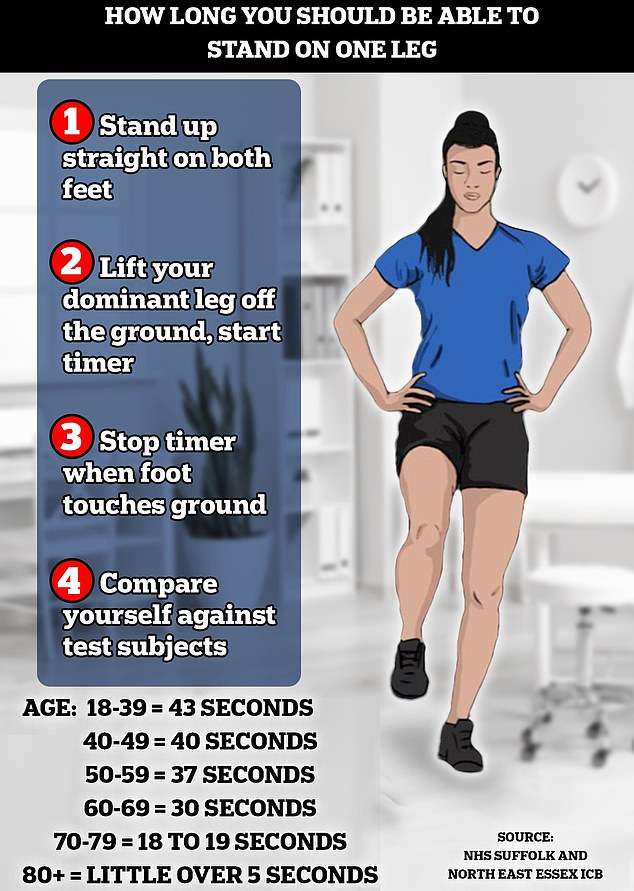



Post a Comment for "How long you should be able to stand on one leg according to your age"